
The Peace Tour
A free collection of stories and audio for everyone who wants to join the Peace Tour in their own way.
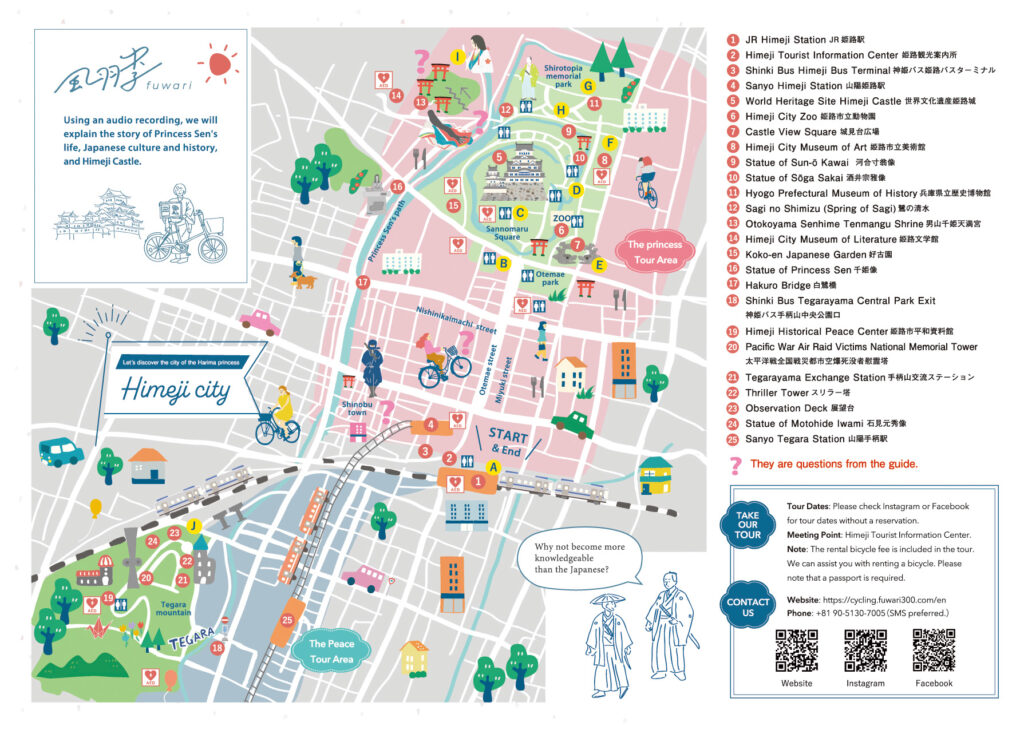
This map shows the cycling area for the Fuwari Peace Tour. The green area in the lower left indicates the Peace Tour zone. Guide commentary is available at stops 19, 20, 23, and 24. At places marked TEGARA, you will find a photo spot with the city name.
TEGARA ―Tegara’s meaning
Tegara is a unique name; there is only one place or mountain called Tegara in Japan.
Understanding Japanese mythology is important to knowing why this place was named Tegara.
According to legend, a god harvested rice by hand, without using a sickle, in this area. This story teaches us the importance of taking on difficult challenges.
There was also a famous swordsmith named Tegarayama Ujiishige who lived on Mount Tegara from the Sengoku period to the Edo period.
The word “Tegara” means achieving remarkable results or honor, either as an individual or as a group.
Let’s achieve something great today and make it a special day!
White egret-Tegara Mountain
Himeji Castle is known by the nickname “White Egret Castle”, and indeed, egrets are often spotted in this area. “Shirasagi” refers to the general term for white egrets.Take a look at this! Six species of birds, including grey herons, little egrets, and intermediate egrets, have built a big colony. Between May and June, the population can reach up to 1,000 birds, including young ones. Although, the people of Himeji are troubled by the egret’s cries and droppings, they watch over them as they grow and protect their natural ecosystem.This is ideal for reproduction as it’s close to the river. By mid-September, the colony will be gone and the egrets will have left their nests.
Even now, you can see them flying gracefully around Himeji Castle.
Pacific War Air Raid Victims National Memorial Tower-Map No.20
This is a memorial tower built with donations from private citizens to commemorate the civilian victims from around the country who died in air raids during World War II.
Dying in an airstrike is terrible and tragic.
I pray for the 510,000 precious souls who suffered that fate.The memorial tower is shaped like a sword stuck into the ground, symbolizing the vow to end war.
In addition, this place was the final stop of the 100km women-only cycling event I organized in Himeji.
Throughout my life, I have searched for my path and it was during this journey that I finally realized my soul’s true purpose in this life—prevent the tragedy of war.
When I had this realization, I wondered what I could do to accomplish this.
I received the answer I had been looking for at that cycling event—it was Memorial Tower.
I thought that it was no coincidence that this place was my destination.
At that time, I didn’t realize the importance of the Memorial Tower, but I would like to bring as many people as possible to this place now.
Himeji Histrical Peace Center-Map No.19
The Himeji Historical Peace Center is an institution by which we acknowledge the tragedy and the suffering that the Second World War caused, to educate future generations and teach them the great value of peace.
Opened on April 26, 1996, this museum specializes in the Second World War and displays remains from the two air raids that hit Himeji, showcases how almost every city in Japan was affected, and shares information about Dr. Masao Tsuzuki, who first discovered the after-effects of the atomic bomb.
In this place, they’ve restored a common house and the cave which was used to protect against attacks.
Many peace education facilities aimed at Japanese people have stopped exhibiting overly horrifying contents over time, but the Himeji Historical Peace Center is a rare peace facility in Japan where you can experience the desperate screams of Harima’s people and the horror of the air raid.
We can relive the terrible experiences of the air attack using a display that reenacts the air attack with pictures, sound, vibrations and a diorama.
Despite these attacks, Himeji Castle remained by the will of the people and god. We hope you can feel just how connected Himeji is to peace.
Kinjiro-Map No.19
Let me tell you about the most famous person in Japan called Kinjiro Ninomiya. Bronze statues of him studying with a bundle of firewood on his back were found at schools all over the country and served as a role model for children. We were taught to study hard and become great people like him.
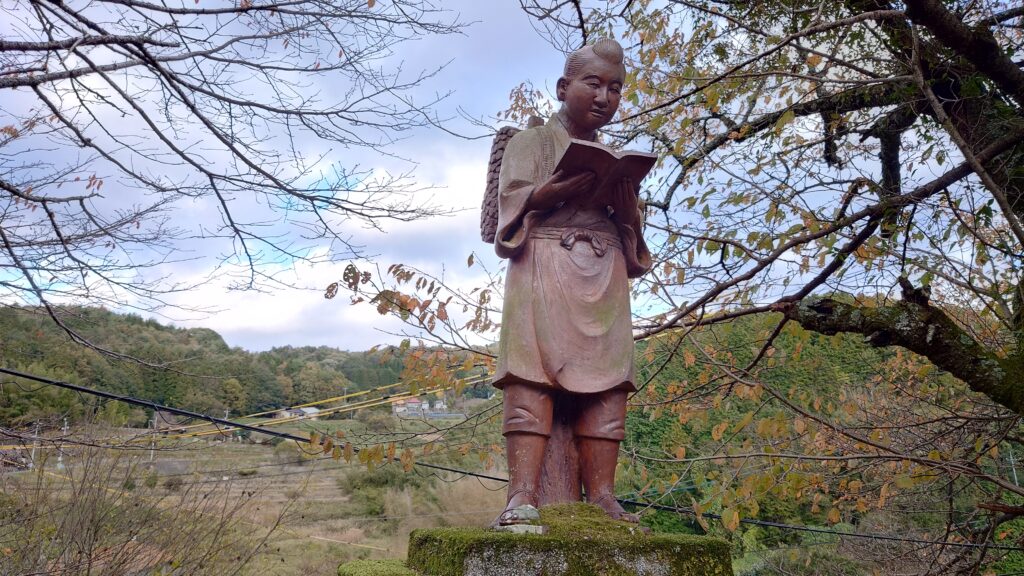
But there was a deeper meaning to his guidance. He is called the “Jesus Christ of Japan”, as
he worked hard to help many people despite facing opposition and obstruction, like that of Christ.
He fasted for 21 days at a temple before attaining enlightenment. That is “Seeing all things as one circle”. This means that even something that appears to be bad at first glance is just one half of the circle; on the other side lies its opposite.
All things coexist in one circle, even though two halves of a circle may seem to be opposites. He found peace within himself by seeing the opposite side of the circle on which things are always better.
It made me wonder, what is the other side of the circle when there’s tragic war?
I would like to reflect on what happened after World War II.
First, it made the world aware of just how terrifying nuclear weapons are. This is because Dr. Masao Tsuzuki, born in Himeji, discovered the atomic bomb effects right away.
Second, there were various technological innovations. Thanks to these innovations, I’m able to easily communicate with you on this tour.
In addition, Japanese schistosomiasis was eradicated thanks to the spraying of pesticides on rice fields as a result of the cooperation of the US military’s Dr. Hunter. Thanks to them—because my ancestor was a farmer, a “hyakushō”—we survived a disease that had claimed more lives than the war.
“Those who cannot remember the past are condemned to repeat it.”
My English teacher taught me this famous quote in America.
I believe that the noble souls who have appeared in Japan are showing us the way to peace.
Note: This statue of Ninomiya Kinjiro is not located in Tegarayama Peace Park.
Dr. Masao Tsuzuki and the Atomic Bomb Disease-Map No.19
Dr. Masao Tsuzuki (1892–1961) was born in Himeji.
Dr. Tsuzuki was a professor at Tokyo Imperial University (now the University of Tokyo) and a leading authority on the biological effects of radiation in Japan. He was a pioneering Japanese medical doctor and naval surgeon, widely recognized as the “Father of Atomic Bomb Disease Research” in Japan. He played a crucial role in the early investigation and treatment of atomic bomb survivors after the bombings of Hiroshima and Nagasaki in 1945.
Dr. Tsuzuki worked closely with both Japanese and American scientists, contributing to joint research efforts on the medical effects of atomic bomb radiation. He is remembered for his scientific rigor, compassion for survivors, and his leadership in the face of unprecedented medical challenges.
For Dr. Tsuzuki, being named the first honorary citizen of Himeji City two years after the war was more than just an honor; it was a profound encouragement and a heartfelt expression of respect from his hometown.
I am happy to be able to tell you about the peaceful world leader who was born in Himeji.
Statue of Motohide Iwami-Map No.24
“If I had served another term as mayor, I might have achieved all of the great ideals of the Kaiten.”
These were the words spoken by Motohide Iwami, who served as mayor of Himeji for 20 years after the war, when he lost the election.
Kaiten were manned suicide torpedoes used at the end of World War II.
When I heard this, it stayed with me. It made me realize that we have been living in such great happiness because of those who risked their lives and those who worked hard to build peace afterwards.
Perhaps it is in moments like these that we can realize what we have been living for.
There is something I sincerely hope for right now. That is the return of those abducted by North Korea. Moreover, I want to convey to the world that Japan has chosen the path to resolving this issue without resorting to war.
Why not peacefully discover your true desire? That will become your greatest achievement at Tegara mountain.
The former mayor believed that the greater the darkness in tragedy, the greater the light on the other side.
I realized that was the great ideal of the Kaiten.
Observation Deck-Map No.23
Observation Deck-Map no.23: This is also the breakthrough sightseeing spot located at point J on the map, offering great views of the castle.
You will be able to take a break looking over Himeji city and Himeji Castle in the distance. When you also see the train moving, it reminds you of the picture book “The Little House” by Virginia Lee Burton. Himeji Castle has been looking over the surrounding landscape for centuries.
We will be holding an origami crane workshop here if you join the Peace Tour, folding two origami cranes—one for you, one for peace. The time you spend for others will deepen your prayers.
We look forward to your reservation!